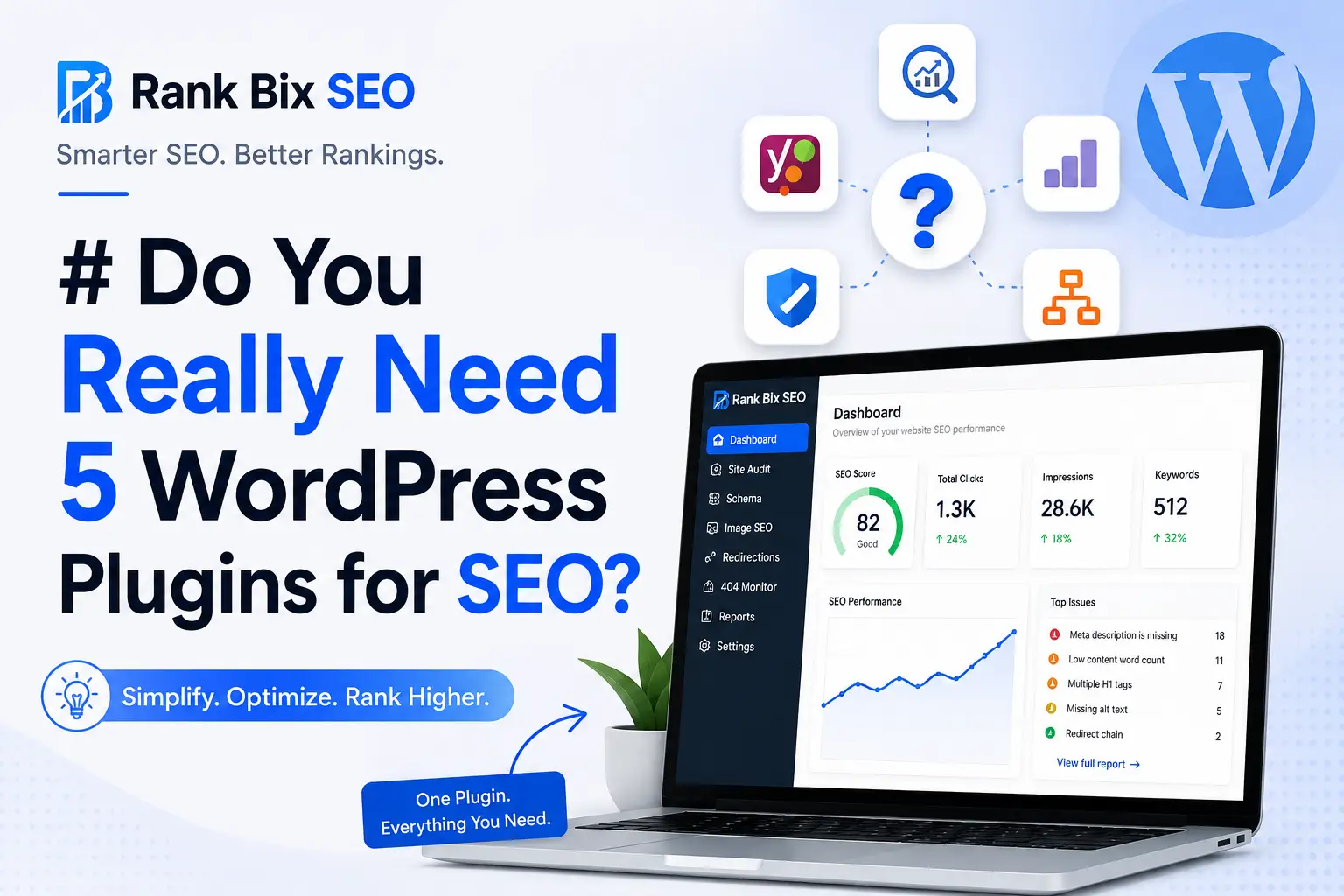
WordPress gives us incredible flexibility, but that flexibility can also create a common problem: plugin overload.
A typical WordPress website may use one plugin for SEO, another for redirects, another for monitoring 404 errors, another for schema markup, and another for newer features such as IndexNow or LLMs.txt.
Before long, a simple SEO setup becomes a collection of different plugins, settings pages, updates, compatibility checks, and potential performance issues.
But does WordPress SEO really need to be that complicated?
The Problem With Too Many SEO Plugins
Installing multiple plugins is not automatically bad.
However, every additional plugin introduces another piece of software that needs to be:
- Updated
- Maintained
- Tested
- Secured
- Configured
- Checked for compatibility
The bigger issue is often duplication.
For example, you might already have an SEO plugin generating metadata while another plugin handles schema, another handles redirects, and another monitors broken URLs.
Some of those plugins may even load overlapping functionality.
For developers, agencies, and website owners, this creates unnecessary maintenance.
The goal should not be:
Install as few plugins as possible.
The better goal is:
Install only the plugins that provide real value.
What Does a Modern WordPress SEO Setup Need?
SEO has evolved considerably.
Today, a useful WordPress SEO toolkit should cover more than just title tags and meta descriptions.
A modern setup may include:
Meta Titles and Descriptions
Every important page needs properly optimized metadata to help search engines understand the content and encourage users to click.
Writing metadata manually can take time, especially on larger websites.
AI-assisted metadata generation can make this process much faster while still allowing editors to review and adjust the final content.
XML Sitemaps
An XML sitemap helps search engines discover important pages across your website.
For most WordPress websites, sitemap generation should be automatic.
There should be no reason to install a separate plugin just to manage a basic XML sitemap.
Schema Markup
Schema helps search engines understand the meaning and structure of your content.
Depending on your website, structured data can describe:
- Articles
- Businesses
- Products
- FAQs
- Breadcrumbs
- Pages
- Other content types
Managing schema from the same SEO dashboard can make the configuration much easier.
Redirect Management
URLs change.
Pages are deleted.
Products are removed.
Content structures are updated.
A redirect manager helps send visitors and search engines from old URLs to the correct new location.
Without proper redirects, users may encounter unnecessary 404 pages and valuable backlinks can point to broken URLs.
404 Monitoring
You cannot fix broken URLs if you do not know they exist.
A built-in 404 monitor can help identify URLs visitors and crawlers are attempting to access.
From there, you can decide whether to:
- Create a redirect
- Restore missing content
- Correct an internal link
- Ignore irrelevant bot traffic
Having both 404 monitoring and redirect management together makes this workflow much simpler.
IndexNow
Traditional search engine crawling can take time.
IndexNow allows supported search engines to receive notifications when URLs are created, updated, or deleted.
Instead of simply waiting for crawlers to discover every change, websites can proactively notify participating search engines.
For frequently updated WordPress websites, this can be a useful addition to the SEO toolkit.
SEO Analysis
Publishing content is only one part of SEO.
Website owners also need to understand whether important optimization elements are missing.
An SEO analyzer can help identify common issues such as:
- Missing metadata
- Poor heading structure
- Indexing problems
- Content optimization opportunities
- Technical SEO issues
The important part is making these recommendations understandable rather than overwhelming users with hundreds of settings.
What About AI Search?
Search is changing.
People are increasingly discovering information through traditional search engines as well as AI-powered tools and assistants.
That is why technologies such as LLMs.txt are receiving more attention within the web and SEO community.
LLMs.txt provides website owners with a structured way to communicate useful website information for large language model systems.
It is still an evolving area, but WordPress website owners are already beginning to think beyond traditional Google SEO.
Modern SEO tools should therefore be prepared for both:
Search engines today
and
AI-driven discovery tomorrow.
This Is Why We Built Rank Bix SEO
Rank Bix SEO was created around a simple idea:
WordPress SEO should be powerful without becoming unnecessarily complicated.
Instead of requiring multiple plugins for common SEO tasks, Rank Bix brings important tools together inside one lightweight WordPress plugin.
The free version includes features such as:
- SEO metadata management
- AI-assisted meta generation
- XML sitemaps
- Schema support
- Redirect management
- 404 monitoring
- IndexNow
- LLMs.txt
- SEO analysis tools
The goal is not to add features simply to make a longer feature list.
The goal is to provide the SEO tools WordPress users actually need while keeping the experience simple and lightweight.
Why Lightweight Matters
Performance is an important part of the WordPress experience.
A plugin should not add unnecessary complexity simply because it can.
For developers and agencies, a lightweight approach can also mean:
- Fewer plugins to maintain
- Fewer dashboards to manage
- Simpler client training
- Easier troubleshooting
- A more consistent SEO workflow
When you manage dozens of WordPress websites, those small improvements can make a significant difference.
One Plugin Instead of Multiple SEO Tools
Think about your current WordPress website.
Are you currently using separate plugins for:
- SEO?
- Redirects?
- 404 monitoring?
- Schema?
- IndexNow?
- LLMs.txt?
If several of those tools could be managed from one lightweight plugin, your WordPress setup could become much simpler.
That is exactly what we are working toward with Rank Bix SEO.
Try Rank Bix SEO Free
Rank Bix SEO is available as a free WordPress plugin.
If you are building a new WordPress website, reviewing your current SEO stack, or simply looking for a lightweight alternative, give it a try.
Install the free version, explore the tools, and let us know what you think.
We are actively improving Rank Bix based on feedback from real WordPress users and developers.
Less plugin bloat.
More useful SEO tools.
A simpler WordPress SEO workflow.
That is the idea behind Rank Bix SEO.