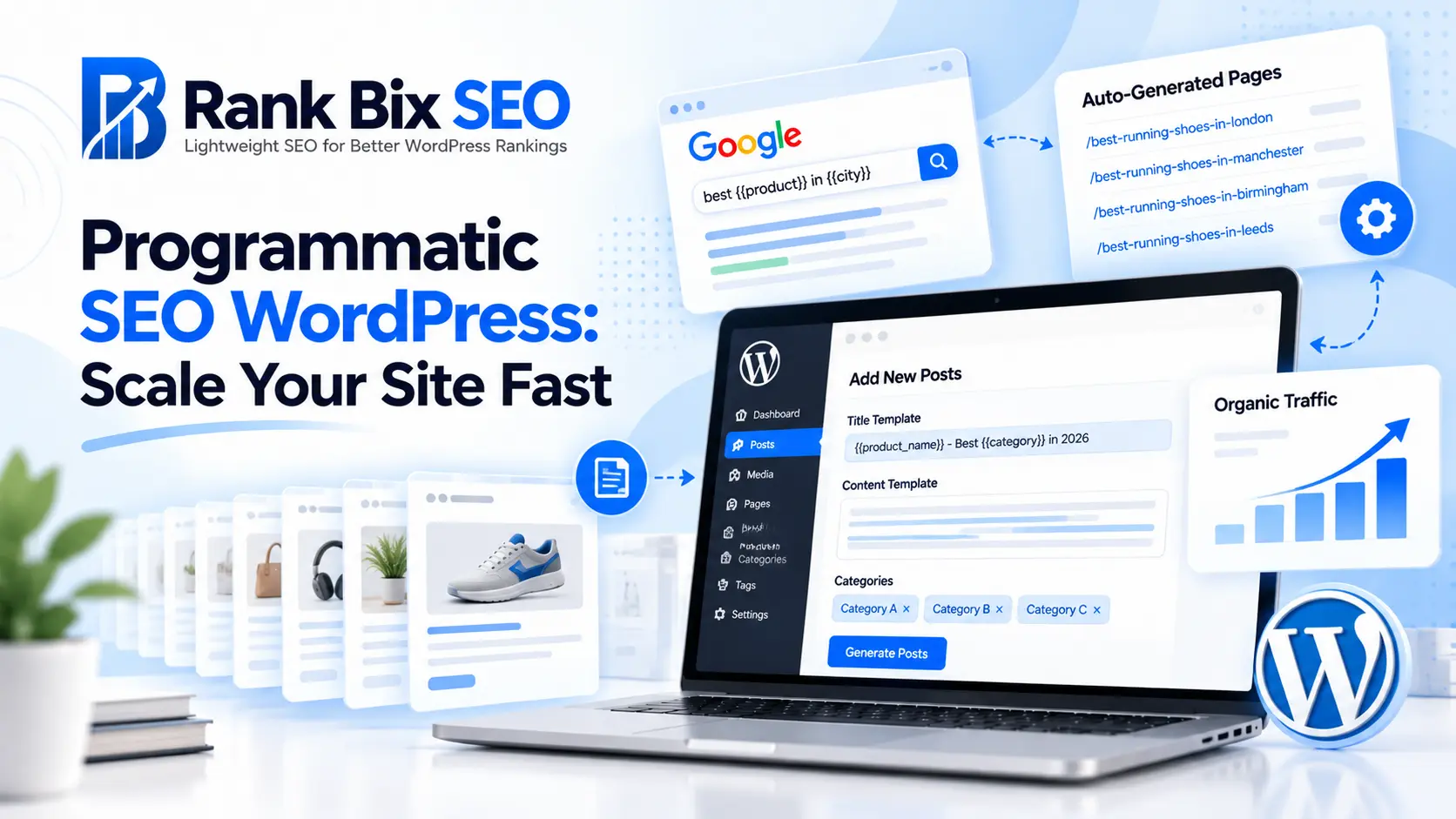
Mastering Programmatic SEO WordPress strategies allows you to scale your website from dozens of pages to thousands without sacrificing quality or spending countless hours writing manually. Whether you run a local business directory, a real estate portal, or an e-commerce comparison site, automating page creation is the ultimate growth hack for organic traffic.
In this comprehensive guide, you will learn how to transition from manual content creation to automated scaling. We will cover the foundational database structures, custom post types, dynamic template design, technical crawl budget management, and how to maintain lightning-fast site speeds using a lightweight approach.
Understanding Programmatic SEO in WordPress
Programmatic SEO involves generating landing pages at scale by combining a database of structured data with a single, dynamic design template. Instead of writing individual posts for every variation of a keyword, you leverage your existing data to build targeted pages automatically. WordPress is uniquely suited for this approach because its underlying architecture relies on a relational database.
For example, if you run a pet-sitting service, a manual approach requires writing a post for “pet sitters in New York,” “pet sitters in Chicago,” and hundreds of other cities. With a programmatic strategy, you maintain a single spreadsheet or database table of cities and run a script or plugin that populates a unified template. The result is thousands of hyper-relevant pages tailored to long-tail search queries.
Structuring Your Database and Custom Post Types
The success of your programmatic campaign relies entirely on clean, well-structured data. Before you generate a single page in WordPress, you need to define your Custom Post Types (CPTs) and custom fields to hold your variables neatly.
To set up your database correctly for scale, follow these steps:
1. Define your core entity. If your site compares software, your CPT might be “Software.”
2. Create custom taxonomies to categorize your data logically, such as industry or pricing model.
3. Use advanced custom fields plugins to assign specific data points-like pricing, ratings, and features-to your post types.
4. Clean your CSV or database entries to ensure there are no missing values, broken characters, or duplicate rows that could trigger quality penalties.
Template Design and Dynamic Content Insertion
Once your custom post types and fields are ready, you need a single template that adapts dynamically to whatever data is pulled from your database. Good programmatic design avoids the trap of thin, repetitive content by ensuring every page offers unique value.
Your dynamic templates should combine static copywriting with custom field tags. For instance, an introductory paragraph might read: “Looking for the best [Software Name] for [Industry]? Compare features, pricing, and user reviews below.” By weaving variables naturally into your headings, meta descriptions, and body text, you create distinct, readable pages that satisfy user intent. Use conditional logic in your template design to display specific blocks only when certain custom fields contain data, preventing awkward empty spaces on your generated pages.
Preventing Index Bloat and
Understanding Programmatic SEO in WordPress
Programmatic SEO WordPress strategies allow site owners to generate hundreds or thousands of optimized landing pages automatically using databases and templates. Instead of writing every post by hand, you target long-tail search queries at scale by combining a structured dataset with a single dynamic layout.
WordPress is a natural fit for this approach because of its relational database architecture. Custom post types, taxonomies, and custom fields native to the platform act as the exact storage units you need to feed structured data into your templates seamlessly.
However, executing this strategy requires a careful balance to avoid search engine penalties. It is vital to distinguish between two different approaches:
- High-value pSEO: Providing genuinely useful, data-driven variations that solve specific user intent, such as localized service pages or product comparison matrices.
- Spammy mass-generation: Spinning thin, low-quality content just to manipulate search engines, which inevitably leads to algorithmic penalties and de-indexing.
Success with programmatic SEO WordPress relies entirely on ensuring every automatically generated page offers unique value to the reader rather than just repeating template text with swapped-out keywords.
Structuring Your Database and Custom Post Types
Scaling your programmatic SEO WordPress project successfully requires a solid backend foundation. If you dump thousands of programmatic pages into standard WordPress posts or pages, your site will quickly become unmanageable. Instead, you need to isolate your programmatic data into dedicated data categories using Custom Post Types (CPTs).
Using Custom Post Types for Distinct Data Categories
Creating a specific CPT-such as “Locations” or “Services”-keeps your programmatic pages separate from your standard blog posts. This separation makes it much easier to manage templates, handle URL structures, and apply bulk updates without affecting the rest of your WordPress site.
Leveraging Advanced Custom Fields for Dynamic Variables
To populate your programmatic templates, you must store your unique variables cleanly. Using Advanced Custom Fields (ACF) allows you to attach structured data points-like city names, population stats, or specific pricing-directly to your CPTs. Your template files then pull these fields dynamically, ensuring every page displays unique content.
Keeping Database Queries Lean for Optimal Loading Speeds
As your database grows to thousands of rows, poorly optimized queries will drag down your server response times. Keep your database lean by following these practices:
- Only create ACF fields that your templates actively use.
- Index your custom meta keys in MySQL if you plan to run complex meta queries.
- Avoid heavy taxonomy relationships unless absolutely necessary for your site architecture.
- Purge unnecessary post revisions and auto-drafts regularly.
A lean database ensures your server handles high-volume traffic smoothly, keeping your site fast and responsive for every user.
Template Design and Dynamic Content Insertion
Building a successful programmatic SEO WordPress strategy starts with designing a single master template that adapts seamlessly to thousands of permutations. Instead of hardcoding text, you map out visual blocks that serve as placeholders for your data. This layout must accommodate both short descriptions and lengthy localized paragraphs without breaking its responsive design.
Inserting dynamic variables safely relies on utilizing custom block fields or lightweight shortcodes tied directly to your database fields. When handling this data injection, always sanitize your inputs to prevent security vulnerabilities and broken strings. Clean execution ensures variables like city names, pricing tiers, or product specs render instantly across every generated page.
The biggest challenge in programmatic SEO WordPress is avoiding thin, duplicate content. To guarantee unique value on every generated layout, incorporate distinct elements such as:
By blending structured database variables with genuinely useful contextual data, you keep your mass-generated pages engaging for visitors and valuable in the eyes of search engine crawlers.
Preventing Index Bloat and Managing Crawl Budget
When you scale a website using programmatic SEO WordPress methods, you risk generating thousands of URLs almost instantly. While volume is the goal, unmanaged scale often leads to index bloat, where search engines waste time crawling low-value pages instead of your most important content.
Preventing index bloat requires active curation of your database. You must identify thin content before search engines penalize your site for offering little to no unique value.
Core Strategies for Crawl Management
- Audit automated variations: Review generated pages to ensure every URL combines enough unique data variables to stand on its own.
- Implement strategic noindex tags: Apply noindex directives to programmatic archive pages, empty filter results, or low-value permutations that rely entirely on duplicate text.
- Refine your XML sitemaps: Exclude low-value programmatic URLs from your primary sitemap, ensuring search engines focus their finite crawl budget exclusively on high-converting money pages.
By protecting your crawl budget, you help search engine bots discover and index your best programmatic SEO WordPress content much faster, leading to stronger rankings and healthier organic traffic growth over time.
Maintaining Speed with a Lightweight SEO Plugin
When you scale a website using programmatic SEO WordPress strategies, your database grows rapidly. Standard plugins often add dozens of database queries per page load, creating a massive bottleneck when thousands of dynamic pages are requested simultaneously. Heavy codebases struggle under this weight, leading to poor Core Web Vitals scores and lost rankings.
Managing metadata efficiently is crucial to prevent database bloat. Instead of storing redundant, custom meta fields for every single variation, your setup needs a streamlined approach that generates titles and descriptions on the fly using your dynamic variables. This keeps your wp_postmeta table lean and your server response times lightning fast.
To maintain peak performance while executing a programmatic SEO WordPress campaign, you need tools built for speed. Here is how you can optimize your workflow:
- Strip out unnecessary bloat by replacing resource-heavy alternatives with a streamlined plugin.
- Leverage Rank Bix SEO Pro for advanced programmatic controls and automated metadata management.
- Monitor your server load and database queries regularly to ensure rapid page delivery at scale.
By keeping your infrastructure lightweight, you ensure that search engine crawlers can index your mass-generated pages efficiently without crashing your server.
Frequently Asked Questions
What is programmatic SEO in WordPress?
Programmatic SEO in WordPress is the practice of creating hundreds or thousands of landing pages automatically using structured datasets, custom post types, and dynamic templates to target long-tail search queries efficiently while maintaining unique, high-value content for users.
Will programmatic SEO hurt my site speed?
It can if your database becomes overloaded with poorly structured queries or if you use a heavy, bloated SEO plugin. By using a lightweight SEO solution and optimizing your custom fields, you can scale to thousands of pages without impacting performance.
How do I prevent Google from penalizing my programmatic pages?
To avoid penalties, ensure every generated page offers genuine utility to the user. Avoid exact-copy templates by injecting localized data, unique user reviews, and dynamic tables. Clean up thin pages and use strategic noindex directives where necessary.
Scale Smarter, Not Harder
Scaling your website using Programmatic SEO WordPress requires a strategic approach across every phase of development. By first understanding the core concepts and structuring your database with proper Custom Post Types, you lay a solid foundation. Next, combining smart template design with dynamic content insertion allows you to generate thousands of targeted pages effortlessly. However, success depends on protecting your site health by preventing index bloat, managing your crawl budget carefully, and maintaining lightning-fast performance using a lightweight SEO plugin.
Your clear next step is to audit your current WordPress database and map out a single data set for a pilot programmatic campaign today.