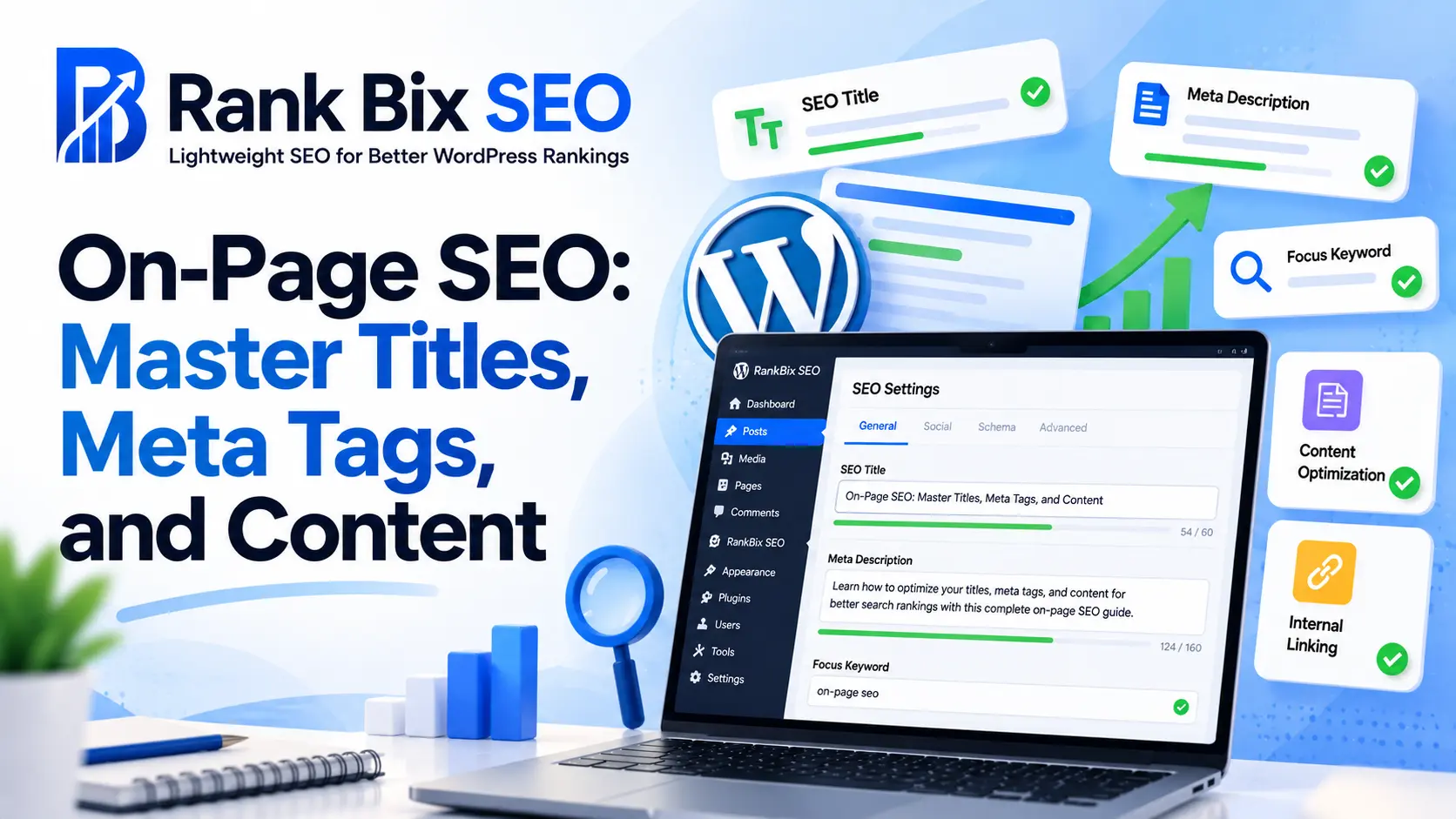
Mastering On-Page SEO is the most reliable way to signal your website’s value to search engines while delivering an exceptional experience for your visitors. Unlike off-page link building, on-page optimization puts you entirely in the driver’s seat of your digital presence.
In this comprehensive guide, you will learn how to build solid optimization foundations, craft irresistible title tags, write high-converting meta descriptions, and structure your content to rank higher. We will also show you how to streamline your workflow using the lightweight Rank Bix SEO plugin to manage your WordPress optimizations effortlessly.
Understanding On-Page SEO Foundations
On-page SEO refers to the practice of optimizing individual web pages in order to rank higher and earn more relevant traffic from search engines. It involves tweaking both the visible content and the HTML source code of a page. Getting these foundational elements right ensures that search engine crawlers can easily index your site and understand its context.
Search algorithms have evolved far beyond simple keyword matching. Today, they evaluate user intent, topical depth, and technical page structure. A strong foundation begins with a clean URL structure, fast loading times, and a logical hierarchy. When search engines can crawl your site without hitting roadblocks, your content has a fair shot at claiming the top spots.
Furthermore, technical readability matters just as much as creative writing. Make sure your site avoids duplicate content issues, uses canonical tags properly, and implements schema markup where appropriate. These foundational adjustments create a healthy ecosystem where your titles, tags, and content can truly shine.
Crafting Click-Worthy SEO Titles
Your title tag is arguably the single most important on-page ranking factor. It is the first thing users see on a search engine results page (SERP), making it your primary pitch for a click. A well-crafted title tells both Google and human readers exactly what the page is about.
Keep your titles under 60 characters to prevent them from getting truncated in search results. Place your primary keyword near the beginning of the title for maximum weight and clarity. However, never sacrifice readability for the sake of keyword placement.
Use emotional hooks or modifier words to boost click-through rates. For example, instead of a bland title like “Best Coffee Beans,” try “7 Best Coffee Beans for a Smoother Morning Brew.” Adding numbers, brackets, or year markers—like “Updated for 2024″—can also dramatically lift your organic traffic without changing your rankings.
Writing Meta Descriptions That Convert
While meta descriptions do not directly influence search rankings, they act as ad copy for your organic listings. A compelling meta description persuades a user scrolling through dozens of results to click on your link instead of a competitor’s.
Aim for a length between 120 and 155 characters. Summarize the core value of the page concisely and include a clear call to action. While keywords in the description do not help rankings, Google bolds them when they match the user’s search query, drawing the eye directly to your snippet.
Consider this formula for a high-converting meta description: Hook + Value Proposition + Call to
Understanding On-Page SEO Foundations
On-Page SEO is the practice of optimizing individual web pages to rank higher and earn more relevant traffic from search engines. Unlike off-page optimization—which focuses on external signals like backlinks—on-page tactics happen directly on your WordPress site. Every tweak you make to your text, HTML source code, and internal structure helps search engines understand your content.
Search engines no longer rely on primitive keyword stuffing. Repeating a phrase ten times in a post will actively harm your rankings today. Instead, modern algorithms prioritize user intent. Your pages must directly answer the questions searchers are asking, providing genuine value and a smooth reading experience.
For WordPress users, execution matters just as much as strategy. Bloated optimization tools often add unnecessary scripts, slowing down your page load times and hurting your Core Web Vitals scores. That is why using a lightweight plugin is essential. By keeping your site fast and lean while still providing robust optimization features, you ensure that search engines can crawl your site efficiently without sacrificing user experience.
Crafting Click-Worthy SEO Titles
Your title tag is the single most important element when it comes to capturing traffic from search engine results pages. Perfecting this aspect of On-Page SEO directly influences whether a user chooses your link or skips to a competitor. To maximize your visibility, keep your titles strictly under 60 characters. When titles exceed this length, Google truncates them with an ellipsis, which often cuts off your core message and drops your click-through rates.
Structure your text so that your primary search phrase appears right at the front. Search engines give more weight to the first few words of a title, and users scan horizontally from left to right. Front-loading your target phrase immediately signals relevance to both audiences.
Beyond technical length and keyword placement, your titles need to hook human readers. Incorporate proven emotional triggers and power words to stand out in crowded search results. Consider these strategic approaches:
- Use numbers and brackets, such as 7 Proven Ways or (Updated Guide), to draw the eye.
- Evoke curiosity or urgency with words like Ultimate, Essential, or Fast.
- Highlight a specific benefit, ensuring searchers know exactly what value they get by clicking.
Writing Meta Descriptions That Convert
Your meta description acts as your organic ad copy in search results. While it does not directly influence rankings, it heavily influences click-through rates. Treating this snippet like a mini-advertisement helps convince users that your page provides the exact solution they need.
To maximize your visibility and avoid truncation, keep your meta descriptions between 140 and 155 characters. Search engines typically cut off text that exceeds this limit, which can ruin your call to action. Staying within the optimal character count ensures your full message displays properly on both desktop and mobile screens.
Including your target phrase naturally in this snippet provides an extra visual cue for readers. When a user searches for a term related to On-Page SEO, engines will often bold your matching words within the description. This draws the eye directly to your listing and signals immediate relevance.
Follow these quick rules to write high-converting snippets:
- Start with a compelling hook or question
- Mention your primary topic naturally
- Add a clear call to action like “Learn how today” or “Read the full guide”
- Double-check your character count before publishing
Optimizing Content for Users and Search Engines
When executing a strong On-Page SEO strategy, your written material must satisfy both human readers and search engine crawlers simultaneously. Start by structuring your text logically using a clear hierarchy. Your main page title serves as the H1, while major sections require H2 tags, and subsections need H3 tags to break up dense blocks of text.
Write comprehensive, detailed paragraphs that immediately address the specific intent behind a user’s search query. Avoid fluff by providing actionable answers, step-by-step instructions, or deep explanations right away. Search engines reward content that thoroughly resolves user pain points.
Best Practices for Content Layout
- Keep paragraphs short and focused on a single idea.
- Use bullet points to summarize complex steps or lists.
- Write in a natural, authoritative voice that keeps visitors engaged.
As you write, seamlessly integrate related semantic keywords—such as latent semantic indexing (LSI) terms and industry synonyms—without disrupting the natural flow of your sentences. Search algorithms rely on these contextual terms to understand the depth and breadth of your page topic, helping you rank for a wider array of relevant search queries organically.
Leveraging Rank Bix SEO for Seamless Optimization
Mastering your copy and technical tags is only half the battle. You need the right tool to keep everything aligned inside your WordPress dashboard. Heavy plugins often drag down your server response times, hurting the exact metrics you are trying to improve. That is why smart site owners choose a streamlined approach to manage their site optimization.
Rank Bix SEO was built to solve this exact problem. It gives you a lightweight dashboard where you can handle all your daily tasks without bloat. Here is how it streamlines your workflow:
- Check critical on-page elements instantly inside the WordPress editor as you write.
- Manage custom titles and descriptions from one centralized location.
- Run real-time analysis to catch missing tags before you hit publish.
- Audit your pages completely free forever without adding heavy scripts that slow down your load times.
Effective On-Page SEO does not require a massive, resource-heavy plugin suite. By combining great copywriting with a fast, efficient management tool, you protect your site speed while securing top rankings. Install Rank Bix SEO today and experience streamlined optimization built for modern WordPress sites.
Frequently Asked Questions
What is the ideal length for an SEO title?
The ideal length for an SEO title is between 50 and 60 characters. This ensures that search engines like Google display your entire headline in the search engine result pages without cutting it off with an ellipsis, protecting your click-through rate and brand messaging.
Do meta descriptions directly impact search rankings?
Meta descriptions do not directly influence search engine ranking algorithms. However, they heavily impact click-through rates. A compelling meta description attracts more visitors from the same ranking position, sending positive user engagement signals to search engines.
How can Rank Bix SEO help with on-page optimization?
Rank Bix SEO provides real-time content analysis, title optimization tools, and meta tag controls directly inside your WordPress dashboard. Because it is built to be lightweight, it speeds up your workflow and keeps your site fast without adding unnecessary database bloat.
Start Optimizing Today
Mastering On-Page SEO requires a holistic approach that connects every element of your web page. We explored the core foundations, learned how to craft click-worthy SEO titles, and discussed writing meta descriptions that convert casual scanners into loyal visitors. We also examined the importance of optimizing content for both human readers and search engines alike.
To put these strategies into action without slowing down your site, your next step is to download and install the free Rank Bix SEO plugin on your WordPress dashboard to streamline your optimization workflow today.